Math Academy Success Stories
Elementary and middle schoolers acing AP Calculus BC, high schoolers publishing research and winning national science competitions, alumni pursuing PhDs in quantum computing, adults rebuilding their confidence in math, and more -- plus how Math Academy makes outcomes like these possible.
Want to get notified about new posts? Join the mailing list and follow on X/Twitter.
I keep coming across success stories from Math Academy students. There are enough of them at this point, that I figured I should just go through my bookmarks and make a post out of it.
These stories are 100% organic – we did not pay for any of them to be posted, and we did not even request any of these students to post their progress. To date, the total amount that Math Academy has spent on paid posts is a flat $0.
This is a living document, and it’s nowhere near a complete list – it’s just the stories I’ve personally come across and bookmarked. I’ll keep adding to it.
Table of Contents
- How It Started -- 8th graders passing AP Calc BC in our original school program; our learning outcomes skyrocketed during the pandemic when we deployed our fully automated learning system; students outside our original in-school program used the system and achieved similarly incredible results
- More Kids Crushing Standardized Tests -- and building confidence, and not just kids who started ahead
- Joe Liemandt uses Math Academy as Alpha School's primary 4th-12th grade math curriculum and calls it the key to their outstanding math results
- What's the Point of Acceleration? -- Former students are pushing the boundaries of their fields of interest
- Not Just for Kids -- plenty of adult success stories too, ranging from adults re-learning math to adults who never thought they could learn math in the first place
- How is All This Even Possible? -- Nerd Levels 1-3
How It Started -- 8th graders passing AP Calc BC in our original school program; our learning outcomes skyrocketed during the pandemic when we deployed our fully automated learning system; students outside our original in-school program used the system and achieved similarly incredible results
Math Academy’s original school program is a highly accelerated 6-12th grade math program in Pasadena where 6th graders start in Prealgebra, and then learn the entirety of high school math (Algebra 1, Geometry, Algebra 2, Precalculus) by 8th grade, and then in 8th grade they learn AP Calculus BC and take the AP exam, and then in high school they study a full undergraduate math curriculum.
It’s the most accelerated math program in the USA, there have been plenty of other news articles written about it, and there’s plenty of other information straight from the horse’s mouth including a summary of events 2014-20 (from Sandy and Jason’s perspective), a summary of events 2019-23 (from my perspective, with a focus on teaching in the school program and getting the algorithms in place to turn it into a fully automated system), and another summary of events 2014-20 that I gave on Anna Stokke’s Chalk and Talk Podcast #42 (I’ll paste the relevant snippet below):
- "So back to this eighth graders taking AP Calc BC story. We originally started as a nonprofit school program founded by Jason and Sandy Roberts. One of their kids, Colby, was on the fourth-grade math field day team, and his parents were coaching that team. Their kid and his friends were all really excited about learning math, so they did the standard fourth-grade field day stuff. But the kids were so excited that they didn’t want to just stop at fourth grade. Something they would often ask Jason and Sandy was, “What’s the highest level of math?”
Jason and Sandy would have to say, “Well, it goes really, really high, but for your purposes, let’s just say it’s calculus, because that’s what seniors in high school take if they are on the honors track.” And the next question was, of course, “When do we get to learn it? Can we learn it now? Can we learn calculus tomorrow?” They were just so excited about it.
Jason and Sandy were teaching a bunch of these kids advanced math, even through fifth grade. They got up through a bunch of high school math and to the point where they could start learning calculus. One thing led to another, and this turned into an official school program that was not just a pullout class but became a daily Math Academy class. There were other cohorts that came in following years.
What this turned into was that we would get students in sixth grade who were solid on their arithmetic. They might know what a variable is, but they didn’t really know how to solve equations or anything. They were kind of at an early pre-algebra level. We would scaffold them up, teach them all of high school math within the next two years -- sixth and seventh grade. Pre-algebra, algebra one, geometry, algebra two, and pre-calculus. In eighth grade, they’d be ready to take calculus.
Then, they would take the AP Calculus BC exam. We got to the point where most of the students who took the AP Calc BC exam in eighth grade passed, and most who passed got a perfect five out of five on the exam.
A couple of things I should say, these are not national talent search students.
How the kids were selected was that they scored at or above the 90th percentile on a middle school math placement exam, which is typically taken by all fifth graders in the district around February or March. They were then invited to join the program. It's a seventh-grade math skills test, so it provides a somewhat high skill level, but it's not designed to identify math aptitude.
This is also in the Pasadena Unified School District, where about two-thirds of the student population qualifies for the federal free and reduced lunch program, and about 44 percent of all K-12 students are educated in private schools, compared to the California average of 11%.
This is not a particularly talented group of students. It's not a biased group of the top students in the nation. Just think of a standard school and kids in the standard honors class. They can be accelerated way, way, way higher than they currently are.
When Jason and Sandy were teaching, they were doing this all manually and achieving very good results. But these results got even better once students started working on the Math Academy system. Jason got tired of the kids saying, “I forgot to do my homework,” or “Oh, I forgot a pencil,” or all these excuses for not doing work. So, he just built a system where he could pick problems for them to do, and then all they had to do was log in at home and do the problems online.
It would automatically grade the problems and keep track of all the kids’ stats, keep track of the class accuracy, and various topics. Over time, this evolved into a system that did more and more of the teaching work.
In the summer of 2019, that’s when Jason pulled me in to make this system a fully automated platform that would actually select learning tasks for students. So, we built this automated task selection algorithm and continued refining it. By the time the pandemic hit in 2020, the big question was how to maintain this level of efficiency from manual instruction.
The answer was, “Well, we have this halfway baked task selection algorithm. Let’s just get it all in place over the summer and put the whole school program on it.” And that’s what we did. That’s how our AP Calc BC scores skyrocketed, from putting them on the system."
We really leaned into the automated system – it allowed us to leverage these learning-enhancing practice techniques to the fullest extent, selecting individualized learning tasks tailored to each student’s own knowledge profile, so that every student would always be working on the exact tasks that would move the needle most on their learning. From my summary of events 2019-23:
- I got involved at the core of Math Academy's software during the summer of 2019. At that time, the software had existed for several years as a tool that Math Academy instructors used to create and grade assignments -- they would manually select problems from the database (which contained a mountain of content written by Math Academy's team of PhD mathematicians), students would complete the problems online for homework, and the software would automatically grade the assignments and keep track of each student's grades. But it was very time-consuming to manually choose a mix of problems that covered the multiple topics taught during class each day and also provided spaced review on previously-learned topics.
It was clear that while students were learning an incredible amount of math, giving the same assignment to each student in a class still left a lot of learning efficiency unrealized: even within a single class, different students had different strengths and weaknesses, had different sets of topics that they were ready to learn, and needed different amounts of practice on different topics to reach a sufficient level of mastery. Giving each student the same assignment virtually guaranteed that every student wasted lots of time being bored or lost -- either way, not actually learning. To solve this problem, different students would need to learn different topics at different times, and get different amounts of practice (including review) on those topics, and each student's learning plan would need to continually adapt to their individual performance.
The need for fully individualized learning, as well as other needs (e.g., financial sustainability and the constant effort to maintain accountability & standards across multiple classes / teachers / schools) led Jason and Sandy to the realization that the only way forward was for the system to become a fully-automated standalone online learning platform, commercially available to the general public. Aware of my background, Jason asked me to develop an algorithm that would automatically assign personalized learning tasks (personalized to each student's individual knowledge profile) while leveraging effective learning techniques like mastery learning, spaced repetition, and interleaving.
By the end of summer the we had an implementation that -- despite being very rough, brittle, and in many ways incomplete -- was good enough to test out with a real student. During the 2019-20 school year, we started out with a single independent learner, a student who was previously in Math Academy and had moved to another state. She learned AP Calculus BC using only the system (i.e. no external help, no human intervention) and got a 5 on the AP exam. This proved the concept that we could upgrade the software from a manual assignment creation tool to a fully-automated adaptive learning system supporting independent learners without any human intervention.
A major transition point happened in Spring 2020, with the onset of the COVID-19 pandemic. I moved in with Jason and his family to quarantine, which led to a makeshift startup incubator experience run out of his living room. We worked every waking hour, well into the night, every day including weekends, so that by the end of summer we were ready to run entire school classes on the automated system. During the 2020-21 school year and COVID-19 pandemic, the automated system proved to be significantly more effective than traditional remote instruction, and by spring 2021 nearly all of Math Academy's school classes were running on it (a couple of which I personally managed as a makeshift usability lab until 2023).
During the 2021-22 school year, even after school was back in person, we reached the point that the system was 4x as efficient as traditional in-person classes covering the same material. Seemingly impossible things started happening like some highly motivated 6th graders (who started midway through Prealgebra) completing all of what is typically high school math (Algebra I, Geometry, Algebra II, Precalculus) and starting AP Calculus BC within a single school year. Math Academy's AP Calculus BC exam scores rose, with most students passing the exam and most students who passed receiving the maximum score possible (5 out of 5). Four other students took AP Calculus BC on our system, unaffiliated with our Pasadena school program, completely independent of a classroom, and all but one of them scored a perfect 5 on the AP exam (the other one received a 4).
Finally, during the 2022-23 school year, we opened up mathacademy.com commercially to the world at large, became accredited, grew to hundreds of commercial users, and hit operating break-even. Even more commercial students aced the AP Calculus BC exam, including an elementary schooler.
Yes, you read that right. We had an elementary schooler get a 5 on the AP Calculus BC exam.
Stephen Huffaker started with our Prealgebra course in 4th grade, completed 7 years worth of math in a year and a half, and aced the AP Calculus BC exam as a 5th grader with a perfect score of 5.
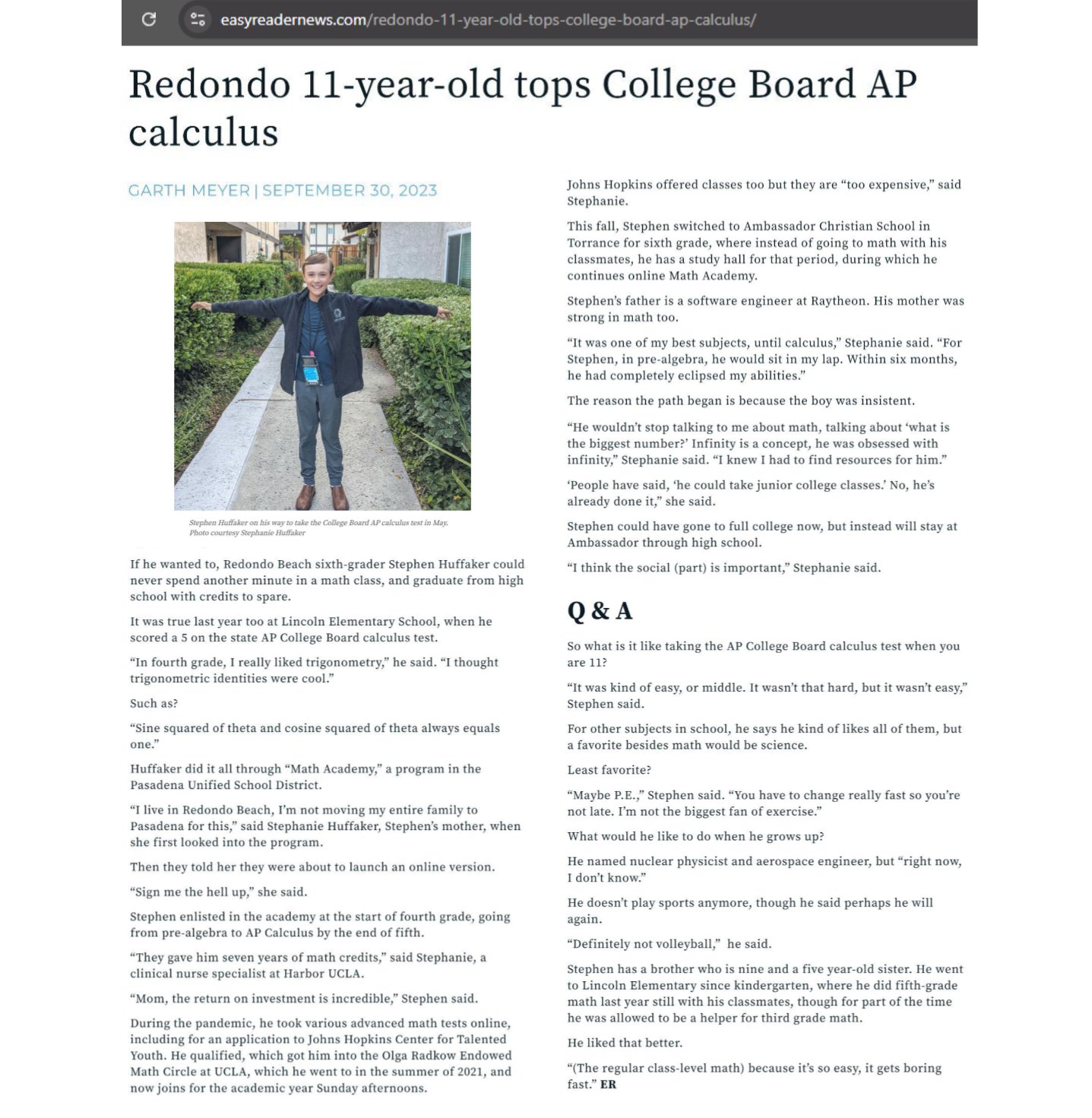 easyreadernews.com/redondo-11-year-old-tops-college-board-ap-calculus
 Stephen wasn’t a one-off, either. In 2026 we had a 3rd grader get a perfect 5 on the AP Calc BC exam, in record pace, finishing six years’ worth of math in just over a year. (The best part: his 6th grade brother got a perfect 5 as well.)
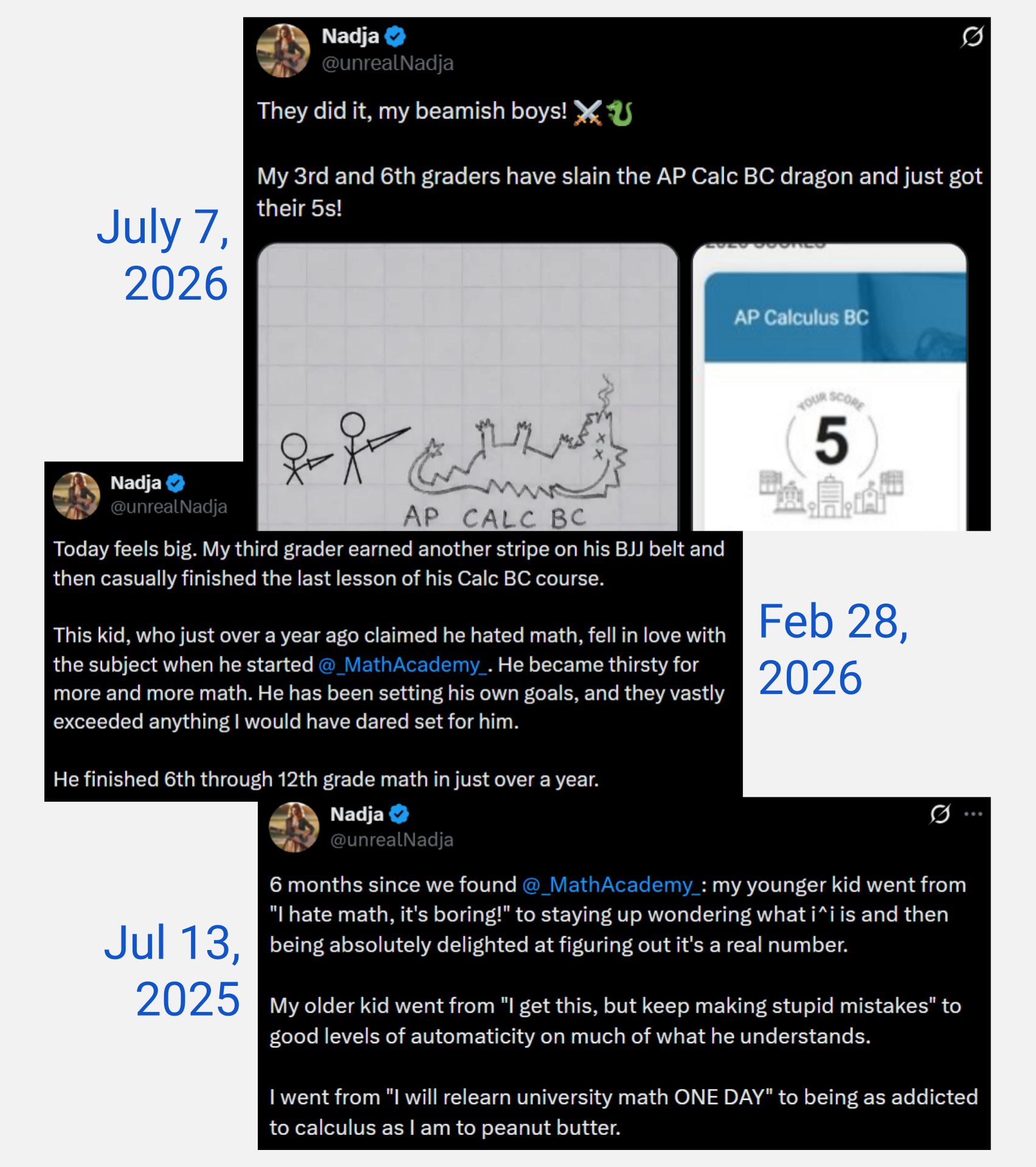 x.com/unrealNadja/status/2074121783502901387
 More Kids Crushing Standardized Tests -- and building confidence, and not just kids who started ahead
The AP Calc BC stories get the headlines because they’re the most dramatic, but they’re really just the tail end of a much wider pattern. Plenty of kids are using Math Academy to get way above grade level and crush standardized tests – SAT, MAP, whatever their school throws at them.
That said, Math Academy isn’t only for kids who are already ahead. Plenty of families use it to catch up, build confidence, and get to (or through) grade level – and many of those kids end up zooming well past grade level once they’re on solid footing. You can use it to go from below grade level to grade level, and then well beyond.
We get a ton of these reports but here are the ones in particular that put the biggest smile on my face:
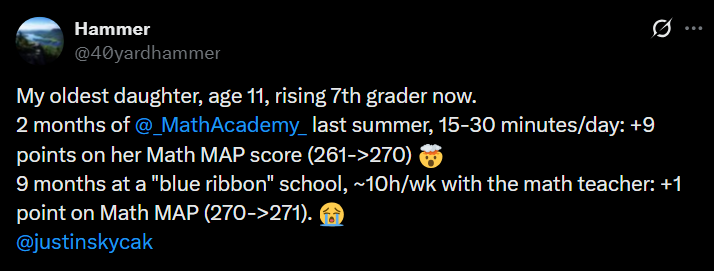 x.com/40yardhammer/status/2065799636988641429
 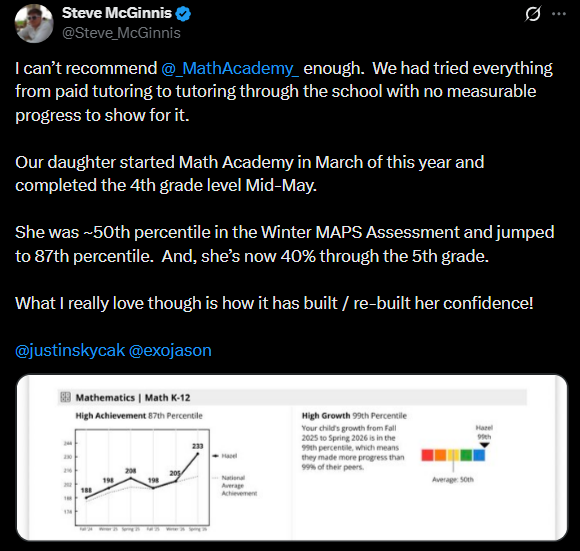 x.com/Steve_McGinnis/status/2069849238284955702
 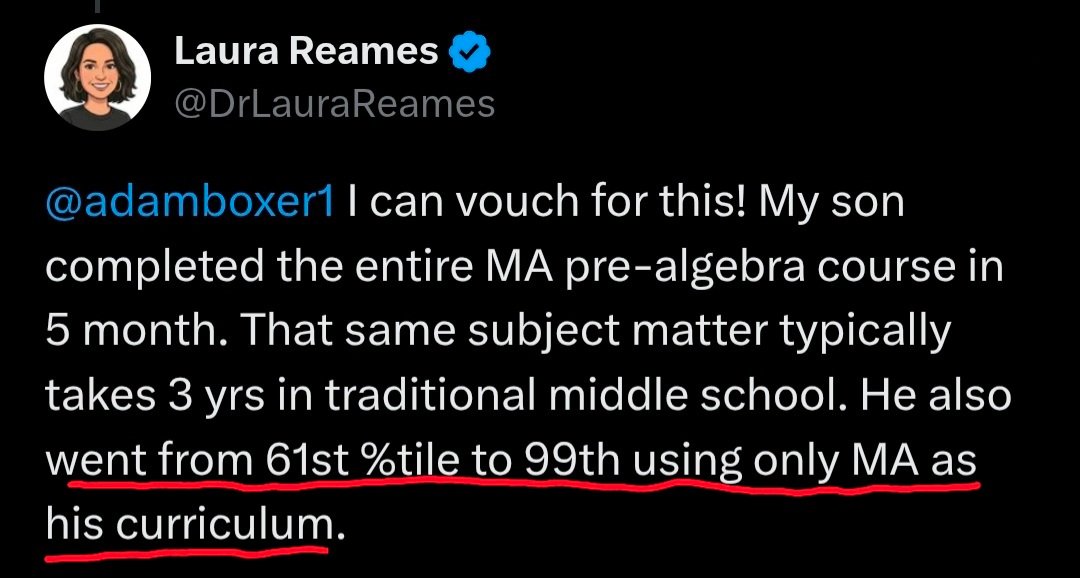 x.com/DrLauraReames/status/2067329427617501414
 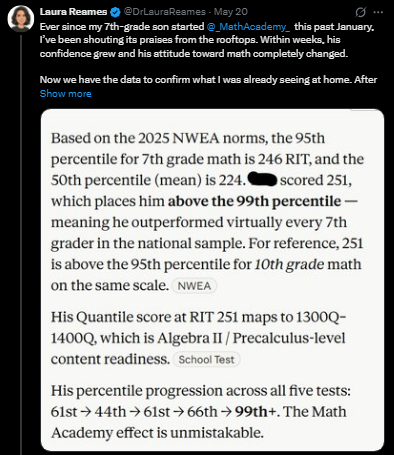 x.com/DrLauraReames/status/2057169224116703501
Note: there is a typo in the Gemini analysis; 251 RIT is 99th percentile for incoming 7th graders, but the student was a graduating 7th grader, and 251 RIT is 92nd percentile for 7th Grade Spring Math 2025 norms. So, the progression was 61st → 44th → 61st → 66th → 92nd. Still incredible!
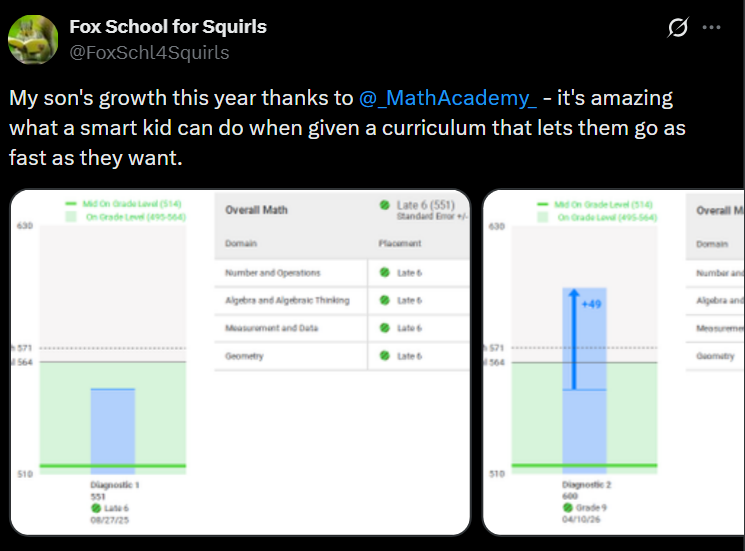 x.com/FoxSchl4Squirls/status/2042771028238045681
 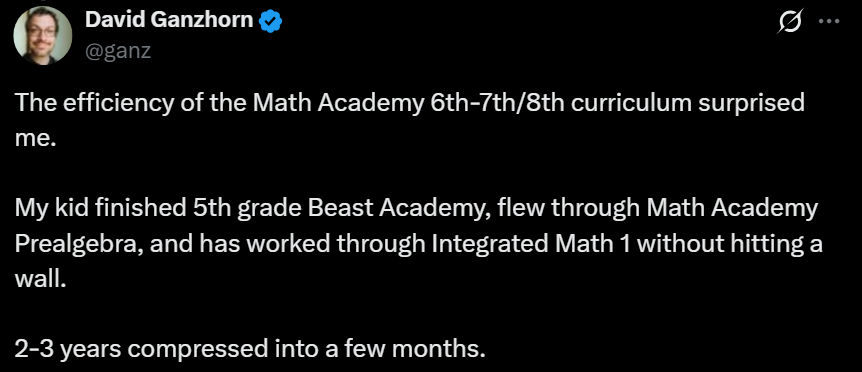 x.com/ganz/status/1978449616388386913
 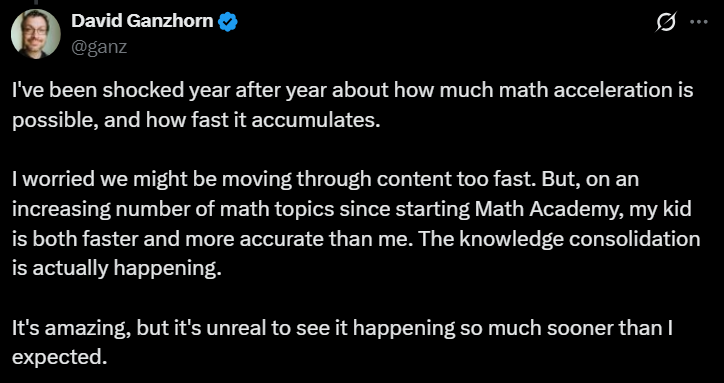 x.com/ganz/status/1978674191621627990
 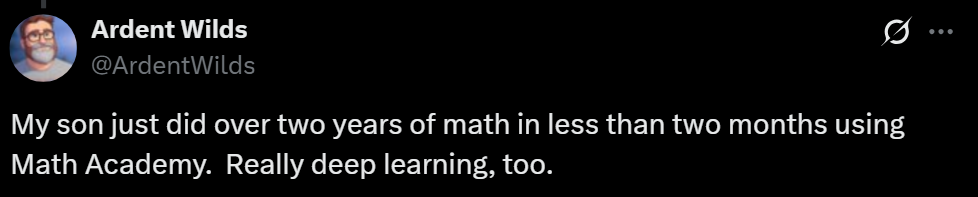 x.com/ArdentWilds/status/2067253365352886714
 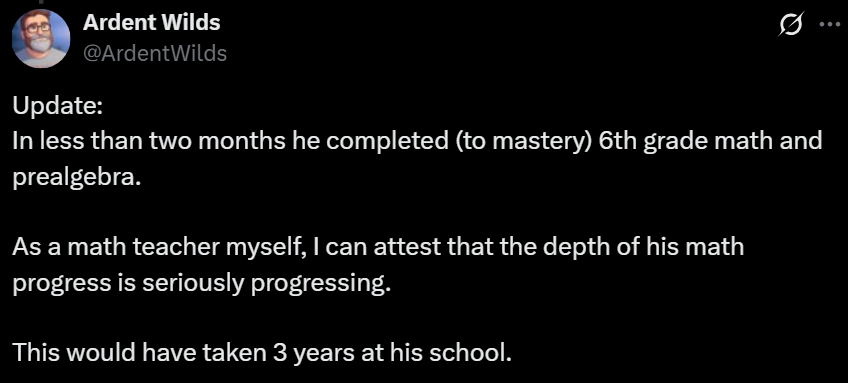 x.com/ArdentWilds/status/2066974719467729130
 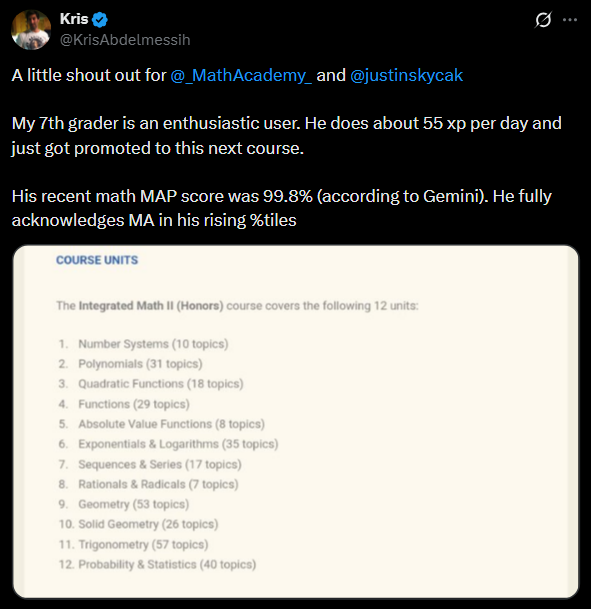 x.com/KrisAbdelmessih/status/2021009929289728387
 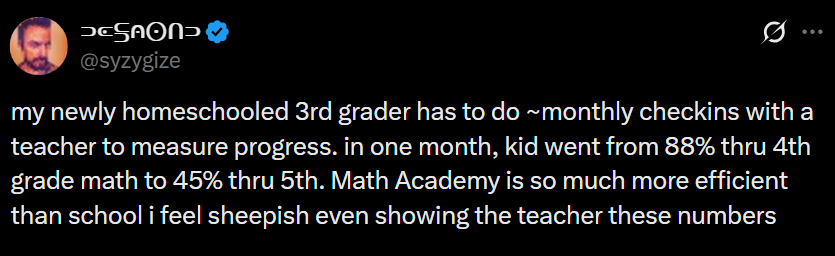 x.com/syzygize/status/1991945349771174382
 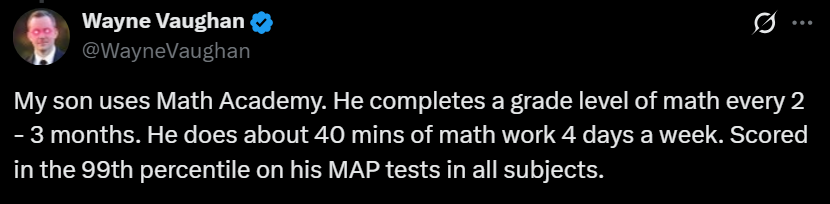 x.com/WayneVaughan/status/2067335896110702960
 Joe Liemandt uses Math Academy as Alpha School's primary 4th-12th grade math curriculum and calls it the key to their outstanding math results
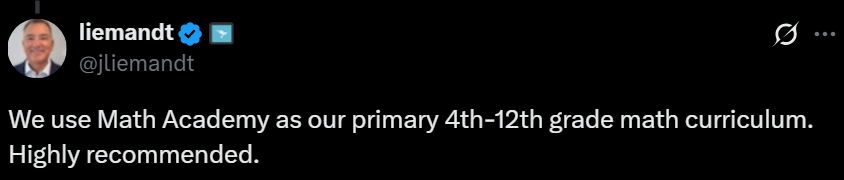 x.com/jliemandt/status/1991856021585924178
 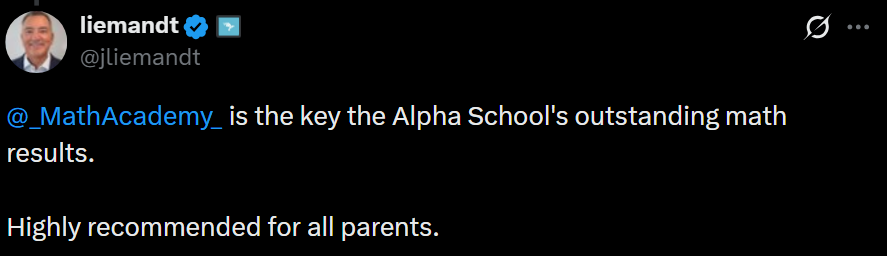 x.com/jliemandt/status/2023171200407462293
 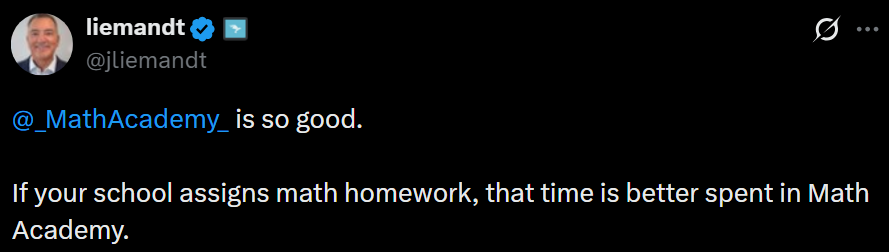 x.com/jliemandt/status/2028154006367859041
 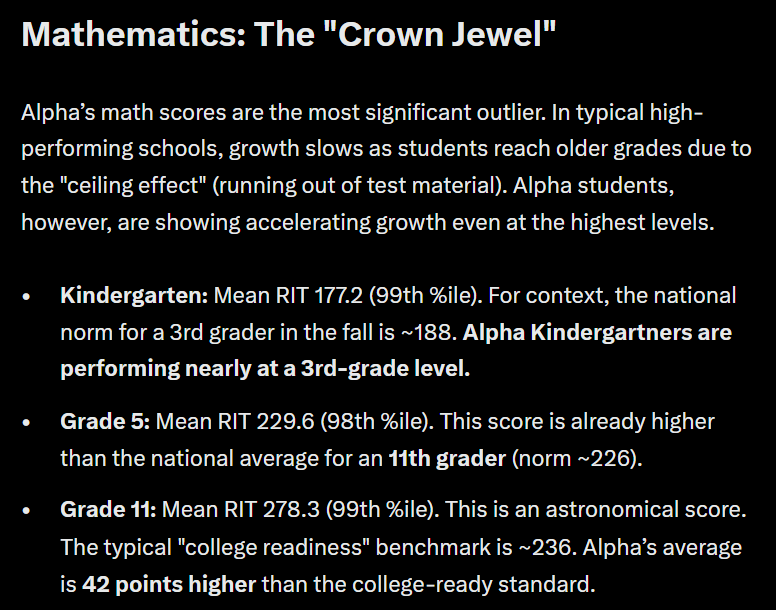 x.com/jliemandt/status/2023011075029922131
 What's the Point of Acceleration? -- Former students are pushing the boundaries of their fields of interest
Every time one of these success stories goes around, someone asks a version of the same question:
- "That's awesome. However, do you fear that they will get bored? What else will they do in school now that they finished all of high school math?"
But it’s less “what can they do?” and more “what CAN’T they do?!”
In our original program, after kids learned calc, they moved right on to undergrad math, and then awesome projects like reproducing academic research papers in artificial intelligence:
- Math Academy’s Eurisko Sequence, 5 Years Later: Student Outcomes Emerging From the Most Advanced High School Math/CS Track in the USA
2025 Mar, ~2700 words • During its operation from 2020-23, Eurisko was the most advanced high school math/CS track in the USA. It culminated in high school students doing masters/PhD-level coursework (reproducing academic research papers in artificial intelligence, building everything from scratch in Python). It's still early and the first cohort hasn't even graduated from college yet, but there have already been some amazing student outcomes in terms of college admissions, accelerated graduate degrees, research publications, and science fairs. - The (Free) Textbook I Wrote While Teaching The Most Advanced High School Math/CS Sequence In The USA
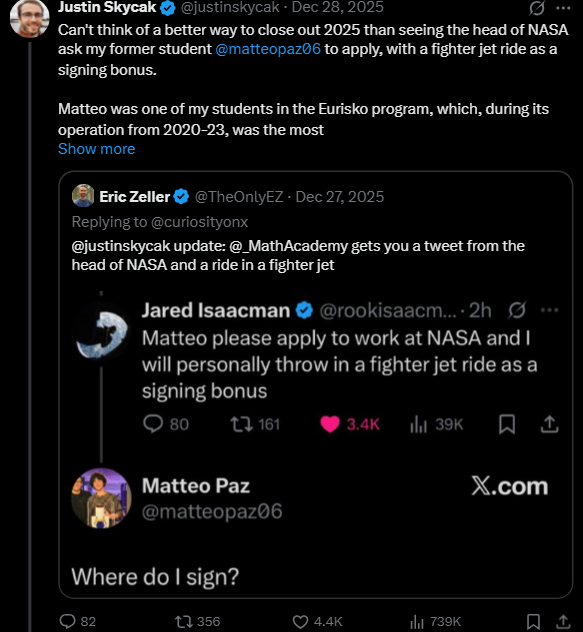
2025 Dec, ~300 words • It scaffolded high school students up to doing masters/PhD-level coursework: reproducing academic research papers in artificial intelligence, building everything from scratch in Python. A former student worked through it right before conducting research that won 1st place ($250,000) in the Regeneron Science Talent Search, getting personally recruited by the head of NASA (with a fighter jet ride as a signing bonus), and publishing his results, solo-author, in The Astronomical Journal.
Of course, the natural follow-up question is “okay, but what comes after masters/PhD level coursework, reproducing ML/AI research papers from scratch” – and the answer is: pushing the boundaries of their fields of interest.
For instance, a former student, Matteo Paz, leveraged his outsized math/coding chops to – as a high schooler – conduct research that “revealed 1.5 million previously unknown objects in space, broadened the potential of a NASA mission” (not hyperbole, a direct quote from Caltech’s website). He published his results solo-author in The Astronomical Journal and won 1st place ($250,000) in the Regeneron Science Talent Search. He also got personally recruited by the head of NASA, with a fighter jet ride as a signing bonus.
 x.com/justinskycak/status/2005159780172628402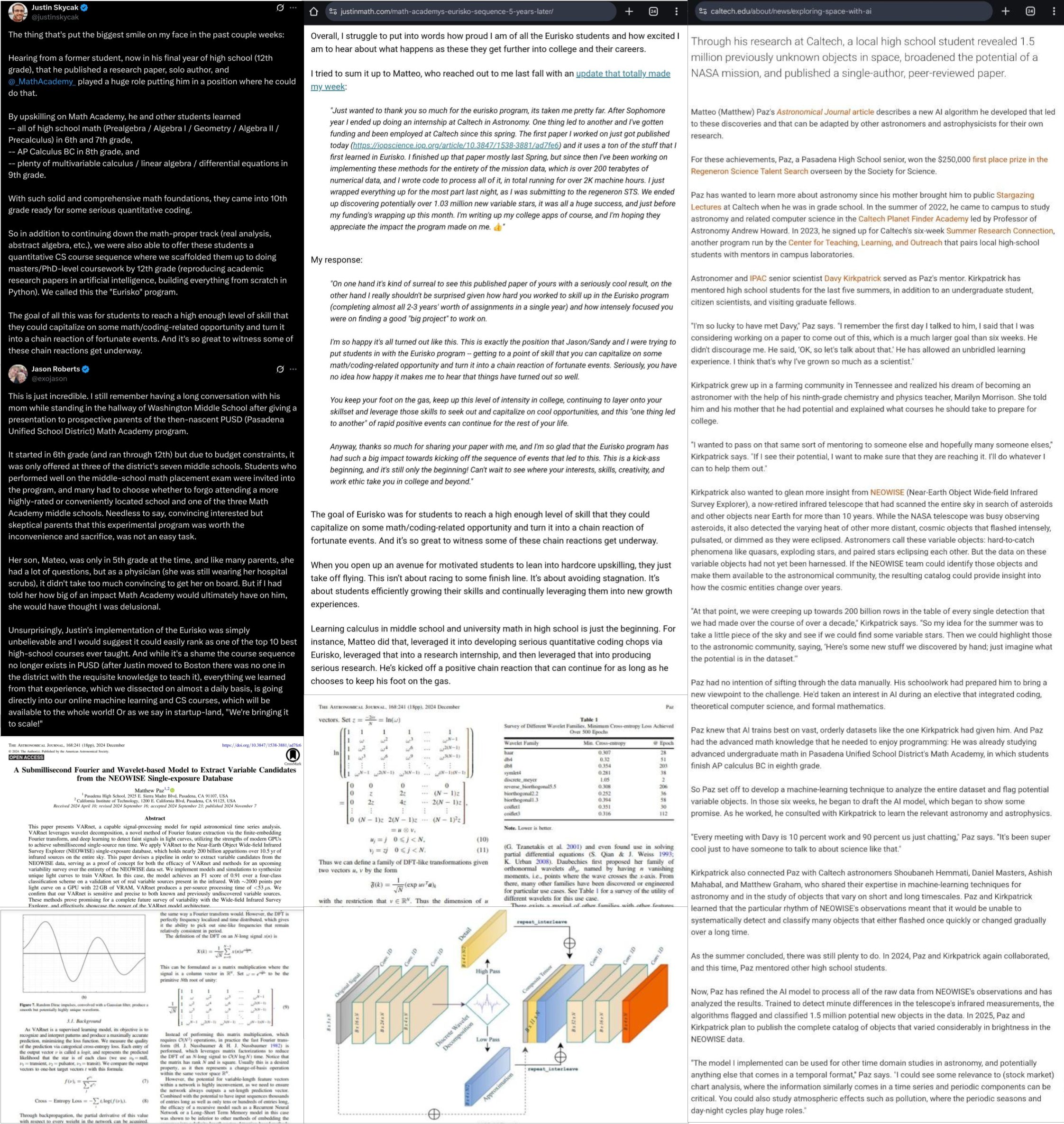
More info:
- A Former Student Got Recruited By NASA With a Fighter Jet Ride as the Signing Bonus
2025 Dec, ~500 words • Matteo won 1st place ($250,000) in the Regeneron Science Talent Search, got personally recruited by the head of NASA (with a fighter jet ride as a signing bonus), and published his results, solo-author, in The Astronomical Journal.
Some other stories:
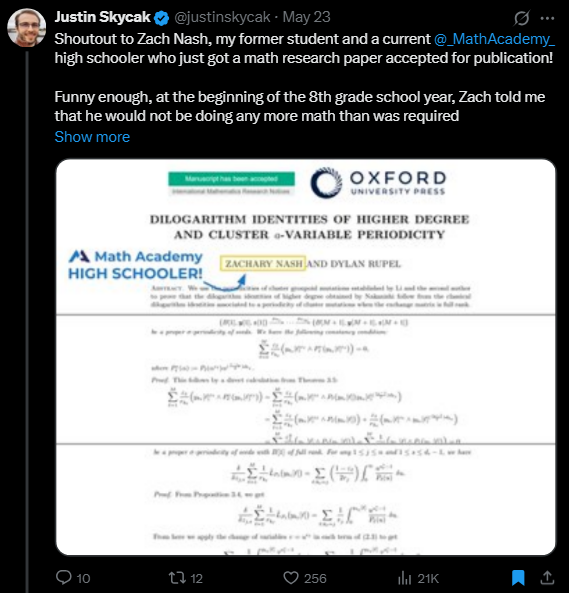 x.com/justinskycak/status/2058270489953657203
 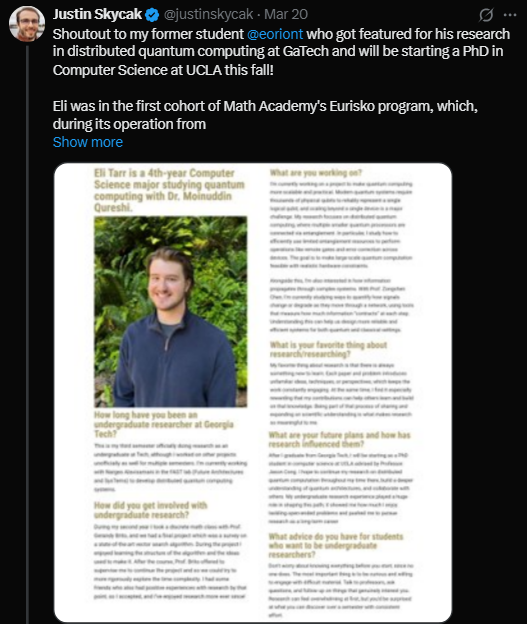 x.com/justinskycak/status/2035025169601728954
 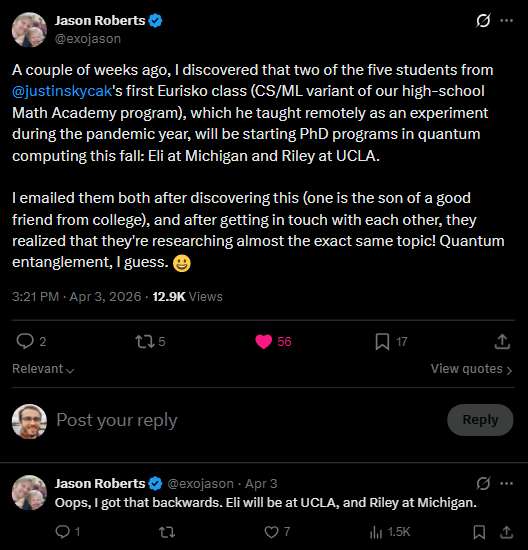 x.com/exojason/status/2040147690739360024
 Related posts:
- What Happens When Middle School is Put to Good Use
2025 Oct, ~3150 words • Typical honors students can learn all of high school math plus calculus in middle school if they are taught efficiently. They don't have to be geniuses, don't even have to spend more time on school. Just need to use time efficiently. Few people understand this, as well as the kinds of opportunities that get unlocked when a student learns advanced math ahead of time. The road doesn't end at calculus, that's just an early milestone, table stakes for the core university math that empowers students to do awesome projects. - ANOTHER Math Academy High Schooler Publishes a Research Paper!
2026 May • Zach Nash told me at the start of 8th grade that he would not be doing any more math than was required to pass the class -- but by the end of the year he had crushed AP Calculus BC, and two years later he had a math research paper accepted for publication. He plans to study math at Yale. - Shoutout to My Former Student Elijah Tarr
2026 Jun • Eli was in the first cohort of Eurisko, Math Academy's most advanced high school math/CS track. He got featured for research in distributed quantum computing at GaTech and will be starting a PhD in Computer Science at UCLA.
Not Just for Kids -- plenty of adult success stories too, ranging from adults re-learning math to adults who never thought they could learn math in the first place
 mikelikejordan.bearblog.dev/how-math-academy-pulled-me-out-of-the-valley-of-despair/
 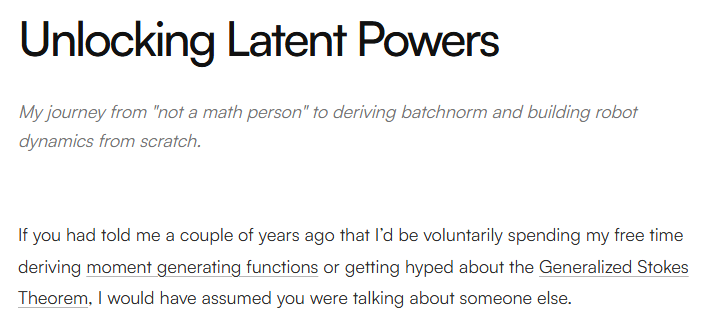 melbournebaldove.com/logs/math-academy-journey
 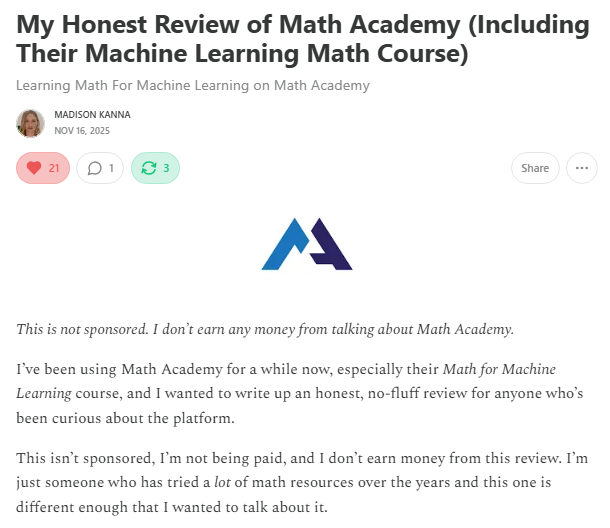 madisonkanna.substack.com/p/my-honest-review-of-math-academy
 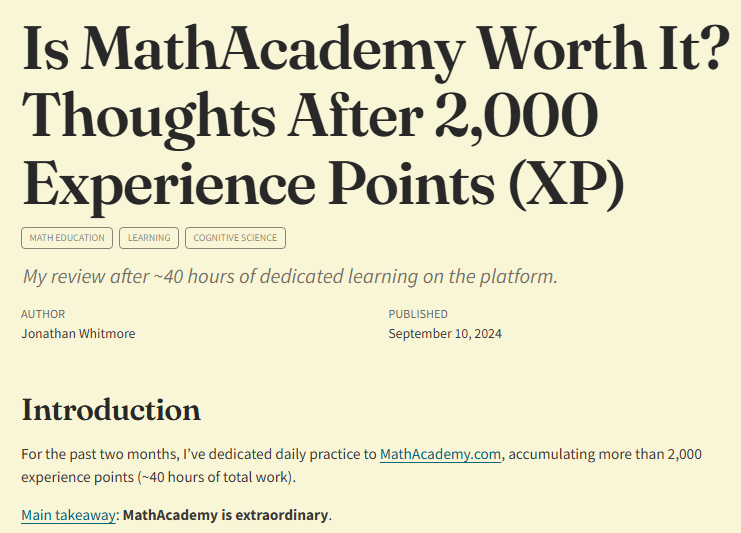 jonathanwhitmore.com/posts/2024-09-10-mathacademy/index.html
 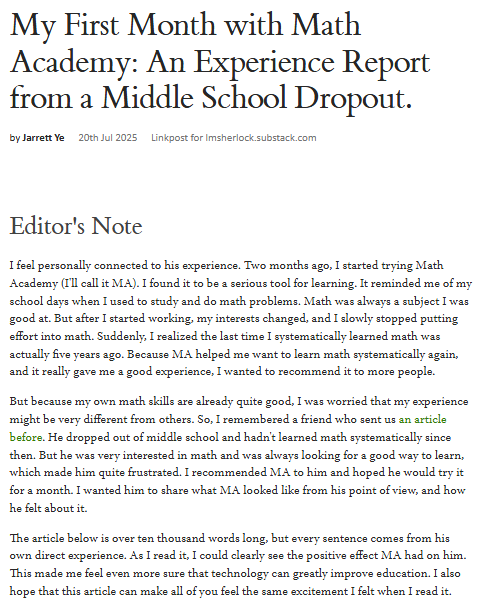 www.lesswrong.com/posts/HxtYuHpa3jzrWsrdm/my-first-month-with-math-academy-an-experience-report-from-a
 How is All This Even Possible? -- Nerd Levels 1-3
Unlike virtually every other math learning program out there, we optimize for learning efficiency, meaning that every action a student takes on the system is intended to maximize the amount of knowledge they learn and retain per unit time they spend working on the system. We accomplish this by providing students with individualized learning tasks matched to their own knowledge profile and pace of learning.
We leverage tons of research into the cognitive science of learning that hasn’t seen the light of day until now. The Math Academy Way explains in forensic detail how all this is possible. Here are some entrypoints, roughly in order of depth:
Nerd Level 1: Why Not Just Learn From a Textbook, MIT OpenCourseWare, Khan Academy, etc.? – I learned from those kinds of resources myself, and while I came a long way, for the amount of effort I put into learning, I could have gone a lot further if my time were used more efficiently. That’s the problem that Math Academy solves.
Nerd Level 2: Overview of our pedagogy, how our AI system works (it’s an “expert system,” throwback to old-school AI) and a deep dive into our spaced repetition system.
Nerd Level 3: The Math Academy Way, our 400+ page working draft book that compiles and synthesizes evidence from hundreds of scientific papers to answer the following questions:
- What techniques exist to maximize student learning and talent development, particularly in the context of math?
- Why are these techniques so impactful, and if they are indeed so impactful, then why are they so often absent from traditional classrooms?
- How does Math Academy leverage these techniques?
The PDF is freely available, so you could probably get some good mileage out of dumping it into an LLM and asking questions.
https://www.justinmath.com/files/the-math-academy-way.pdf
The table of contents of The Math Academy Way is very extensive and functions as a summary of the book. Each chapter also has a one-paragraph summary. Here is a not-too-out-of-date collection of all that summary info.
Here is a post summarizing the main thesis:
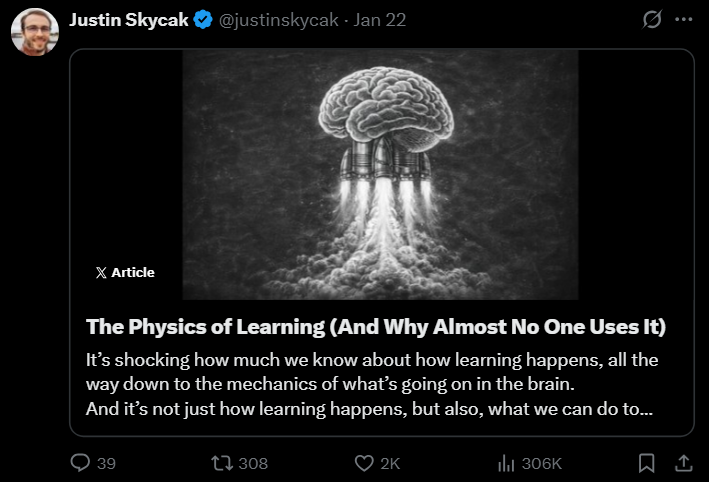 x.com/justinskycak/status/2014496697481605246
 Here are some reviews:
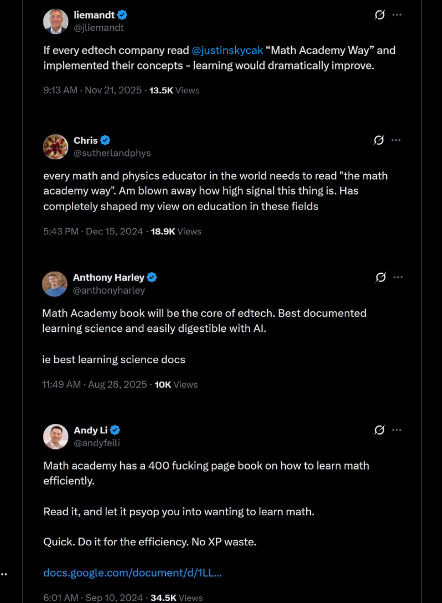 x.com/jliemandt/status/1991872586092052776
x.com/sutherlandphys/status/1868426749949943999
x.com/anthony_harley1/status/1961093851344462092
x.com/andyfeili/status/1833445613704515840
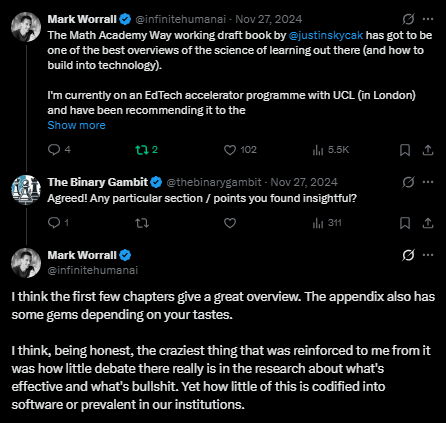 x.com/infinitehumanai/status/1861806755237269614
 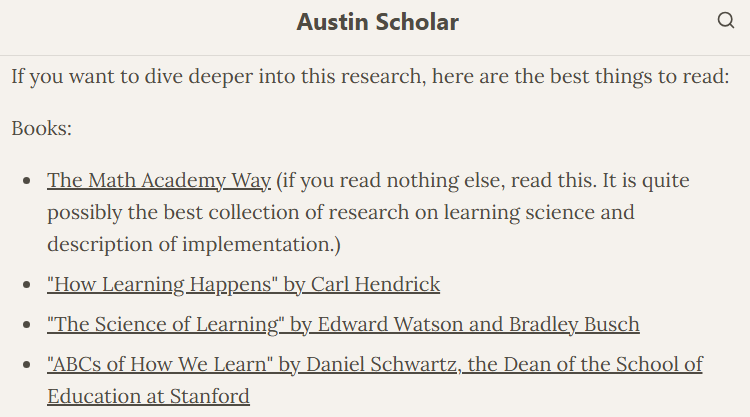 austinscholar.substack.com/p/austin-scholar-173-the-science-behind
Want to get notified about new posts? Join the mailing list and follow on X/Twitter.