Announcing our SAT Math Prep Course
Want to get notified about new posts? Join the mailing list and follow on X/Twitter.
We released an SAT Math Prep course today! This is the culmination of our full-assed, full-nerd effort to bridge the gap between standard school math and the kinds of problems that show up on the SAT.
The goal is to
- produce students with a high degree of skill in the subject matter, like well-trained athletes
- and ALSO make sure they are particularly well-practiced defending against the particular plays/tricks that their opponent (the test) is most likely to run in the upcoming game.
How The SAT Tries To Mess Students Up
The thing a lot of people don’t realize about the SAT is that it is a well-trained opponent who has made a career out of studying your game and figuring out what’s most likely to mess you up.
Coming up against these types of questions is like entering a fight with a professional boxer who has made a career out of exploiting any weakness their opponent might have.
If you have solid fundamentals but are untrained on what to expect from this particular opponent in the ring, you are most likely going to get your ass handed to you.
It doesn’t matter if you could eventually figure out how to beat your opponent in a longer fight.
It doesn’t matter if you could knock them out with a wind-up punch but they keep moving around and throwing off your balance.
It doesn’t matter if you can block a freaking bulldozer but they keep faking you out and sliding punches around your blocks.
When you are going up against an opponent who is pulling out every trick in the book, you absolutely have to train on specific situations that might show up in the game.
Baseline athleticism is necessary but it is not sufficient to win.
You need to know in advance what kind of tricks your opponent might pull, what kind of weird attacks to expect, how to defend against them – and even further, you have to build reflexes that will enable flawless execution come game day.
That’s the kind of training experience we built this course to deliver.
Example: Confusing Questions
Many SAT questions are intentionally set up to increase cognitive load and confuse/trick students.
If a student is encountering these types of questions for the first time while taking the exam, then they’re cooked.
It doesn’t matter if you could have figured it out eventually on your homework, but ran out of time on the test.
It doesn’t matter if you got the core of the solution right but just fell for a “silly mistake” trap while executing it.
It doesn’t matter if the question is long-winded and all you missed was some little detail that you would have realized if the question had just been stated more clearly and concisely.
That’s why it’s so important to prepare beforehand.
Not just baseline mathematical athleticism, but also practicing against on the specific plays your opponent (the SAT) is going to run.
To illustrate, here’s an example from an official SAT practice test – we informally refer to this question type as “riddles” with exponential functions.
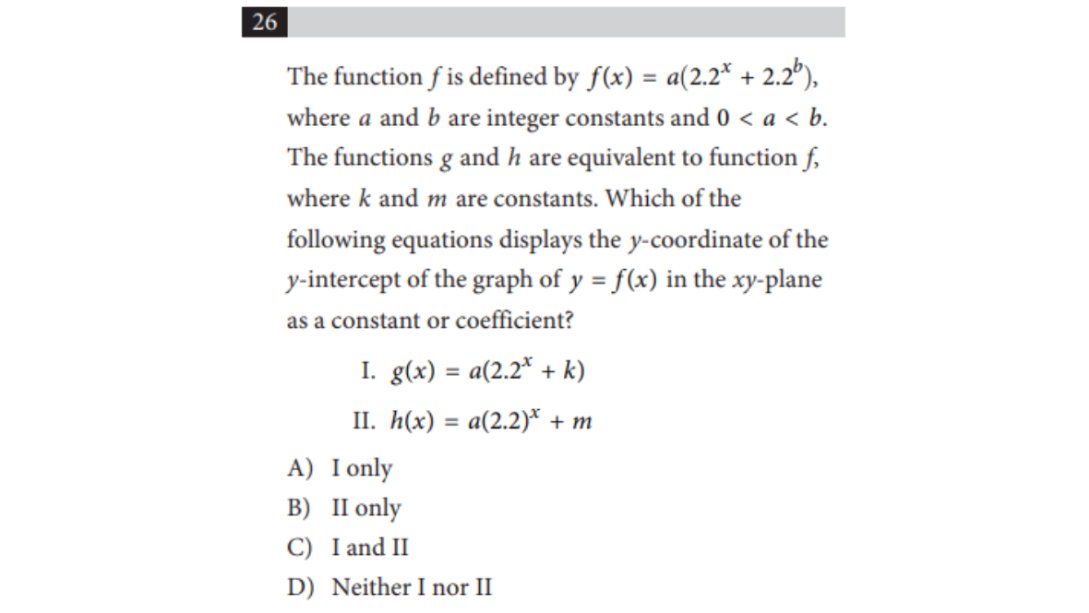
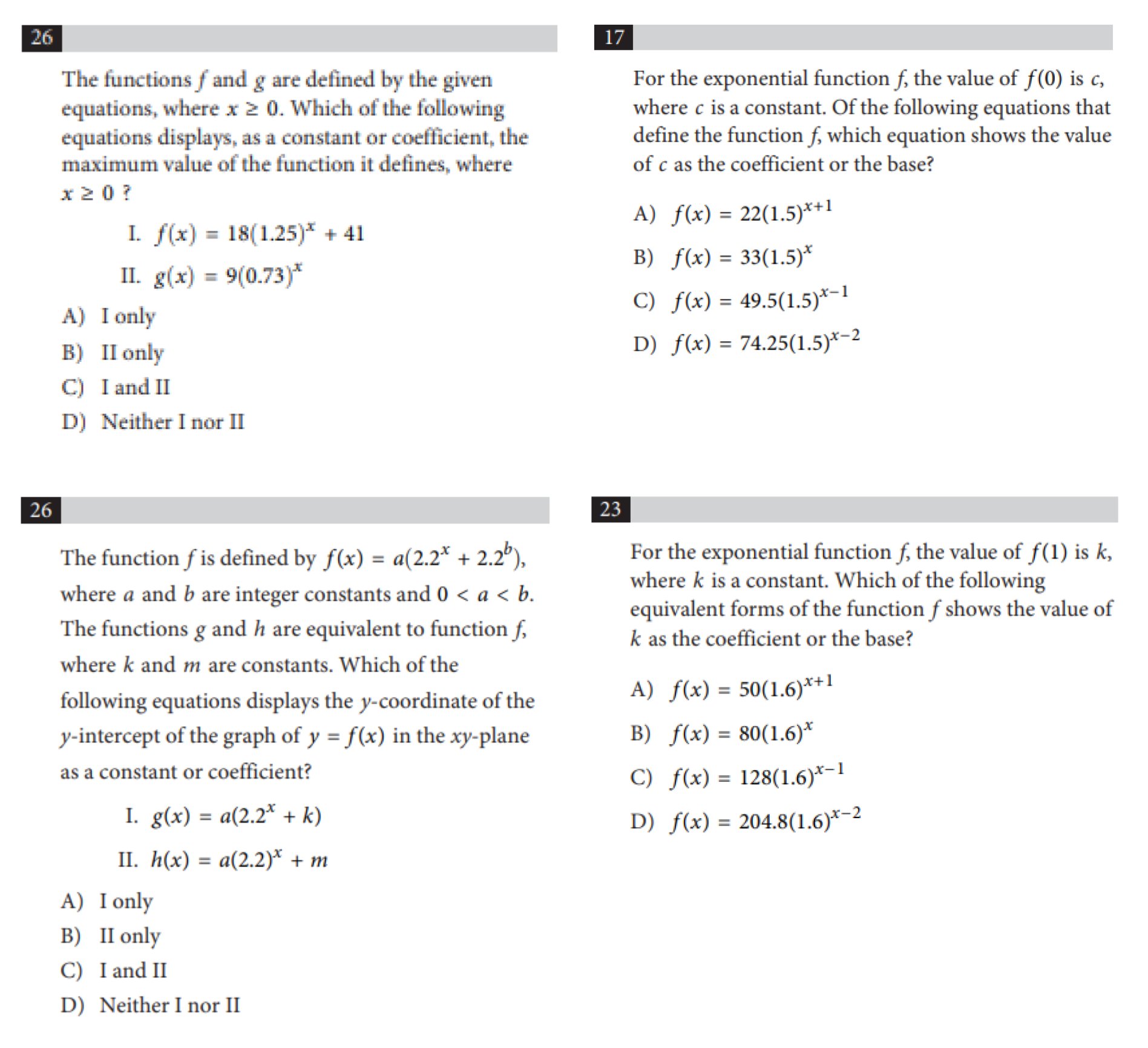
This category shows up across quite a few other official tests too, not just one. In fact, it shows up on 4 of the 7 official practice tests.
Example: "The Time Sink"
Here’s another example of a technique that standardized tests use to defeat students who have baseline foundations in place but haven’t prepared for the specific exam.
I call it the “time sink”.
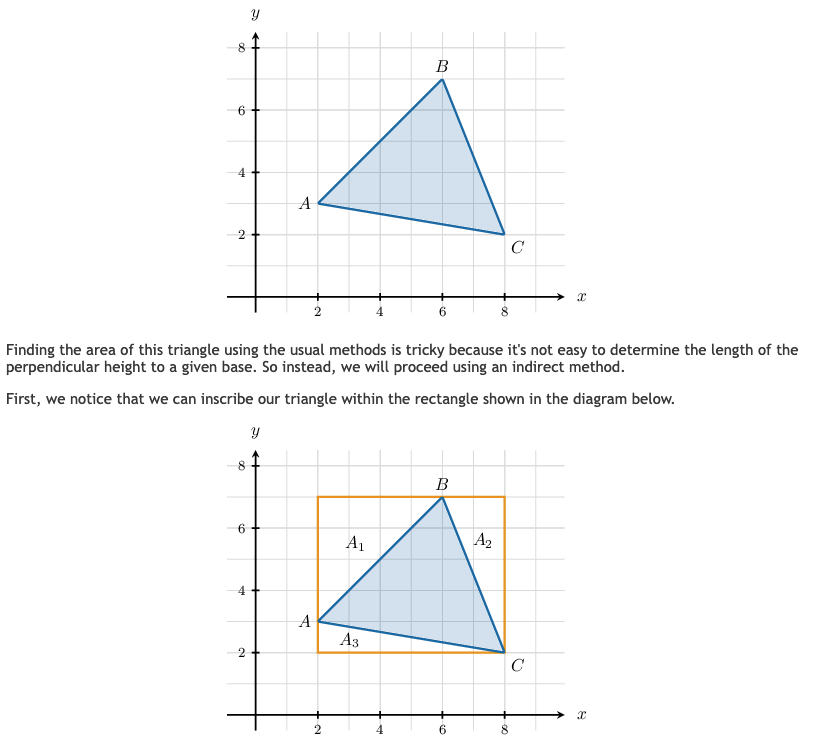
If you come at this problem with strong foundations but weak test-specific preparation, you will most likely try to compute the height of the triangle relative to base AC so you can 1/2 * base * height.
And that’s the trap.
That method would work fine in an untimed setting – it’s a fine approach to a homework problem. But it takes a while, because you have to do a lot of computation. It’s a time sink.
On the SAT you are under extreme time pressure. You only get about 90 seconds per question on average (35 minutes for 22 questions), and even that’s cutting it close, running out the clock exactly with no slack.
So you have to avoid the time sinks. If you fall into too many time sinks, you run out of time.
The most elegant and robust defense against this problem is to inscribe the triangle in a rectangle and subtract off the areas of the three surrounding right triangles. Takes about 30-45 seconds.
But this trick is typically not covered in standard curricula.
It’s easy & straightforward once you’ve seen & practiced it, but most students will not discover it on their own, much less under extreme time pressure.
And even if you happened to see it a while back, if you don’t have an automatic reflex mapping this problem type to the inscribing technique, there’s a good chance you’ll still fall for the time sink.
It’s not just about knowing how to do the trick, it’s about knowing when to do it, and being able to make that decision almost instantly under stress and time pressure.
That’s why even the most fit and talented athletes study their opponent’s game tapes and tailor their practice to that specific opponent leading up to game day.
Academics is no different.
The Missing Middle
The “inscribing” trick discussed above is a perfect example of the kind of skill that shows up on the SAT, but most students won’t learn it even if they ace all of their math classes at school.
There is a gigantic “missing middle” on these exams, a chasm between the standard curriculum and what’s on the test, the purpose of which is to raise the ceiling of the test’s ability to measure
- cognitive advantage (IQ, generalization ability, etc.) and
- willingness to put in the work to train up their skills outside the standard curriculum.
But unfortunately, most SAT prep resources either address little to none of this “missing middle,” and whatever is addressed is typically presented with so little pedagogical effort that even highly capable and motivated students find it difficult to process.
As a result, the “missing middle” primarily serves to measure (1) and not (2).
We are changing that. We identified this gigantic missing middle and added it to our finely scaffolded knowledge graph, so that we can put hardworking students in the best possible position to succeed on these exams.
By the way, we’ll be doing this for the ACT too, and all the other common exams. And it’s the same idea for competition math, where the missing middle is even bigger.
The Unreasonable Effectiveness of the Knowledge Graph
“Problem solving” is often treated as something nebulous – students are told they need to think critically or learn how to solve problems.
But if you push on that idea with enough precision and accountability, it stops being vague.
You ask: what exactly must the student do, step by step, to solve this problem?
When you analyze enough problems at that level of detail, you find that the tasks decompose into explicit, enumerable skills.
And once those skills are identified, they don’t exist as an unstructured list.
They form a connected body of knowledge with clear dependencies – some skills build on others, some combine, some generalize.
In other words, they organize naturally into a knowledge graph.
From that perspective, SAT “problem solving” isn’t an amorphous ability at all.
It’s a structured domain: a finite, hierarchical network of skills that can be mapped and taught systematically.
When people say students need to learn “problem solving” or “critical thinking,” they’re usually pointing to this body of knowledge without realizing that it can, in fact, be made explicit and exhaustively described.
That’s the unreasonable effectiveness of the knowledge graph.
The Manifold Hypothesis
In developing the SAT curriculum, we came face-to-face with the manifold hypothesis playing out.
The manifold hypothesis being that all of life takes place in this very high-dimensional space – there’s tons of possibilities of things that in theory could potentially happen – but the things that actually happen lie in a much lower-dimensional subspace within that space.
On the SAT, there are tons of foundational skills, and they can be pulled together in so many different ways.
Typically people throw their hands up and say “The complete space of possible problem types is too big to teach explicitly. There are hundreds of skills you need to cover and any problem can combine several of them. Millions of combinations are possible. You can’t explicitly teach that many problem types. All you can do is cover a scattered sample and hope that your students have enough generalization ability to fill in the gaps.”
To that I say: you just don’t know what the manifold is.
Once you actually look at the exam and you see the skill combinations and problem types that show up over and over again, you realize it’s a much, much smaller space.
In theory the SAT could span an astronomical space of possible problem types, and if you just glance at one or two tests you might think that it does.
But in reality, the problems that actually do show up live in a proportionally tiny subspace (i.e., a manifold).
It’s not this astronomically large number.
It’s a little over a hundred “missing middle” topics.
Don’t get me wrong, the subspace is still pretty big in an absolute sense, pedagogically speaking. It’s not a trivially small number, but it’s not astronomically big.
And you can enumerate it exhaustively via explicit instruction.
You can build a highly scaffolded curriculum that takes a student – even one who’s not particularly mathematically gifted – and get them explicitly filling in these gaps that normally only highly gifted students would typically infer on the fly, at least, on the subset of knowledge that’s covered on the SAT.
But in order to find the manifold, you have to go on a serious archaeological expedition.
You can’t just glance at a couple exams and throw your hands up and shout “it’s incompressible” after seeing a bunch of different problem types.
You have to dig a lot to find pieces of the manifold skeleton – but once you find a few, it leads you to more – and once you unearth the whole skeleton, it’s mind-blowing how well it compresses what you originally thought might be a combinatorial explosion.
It makes me wonder how compressible competition math is.
Want to get notified about new posts? Join the mailing list and follow on X/Twitter.